Your Cells Are Running a Xerox Business (And You're Not Even Invited to the Meetings)
Welcome to Being Alive (You're Welcome)
Congratulations on existing. You had absolutely nothing to do with it, but here you are, breathing, blinking, and probably scrolling through this article when you should be doing something productive. And do you know what's keeping you alive right now? Trillions of microscopic workers running the most elaborate photocopy operation in the known universe, 24/7, without overtime pay, bathroom breaks, or your permission.
You think you're in charge of your body? Adorable. You're not even CC'd on the emails.
Let me tell you about transcription, the process that's been happening inside you since before you had opinions about things, and will continue long after you've forgotten whatever you learned in high school biology (which, let's be honest, was probably mitochondria-related and you got it wrong anyway).
First, Let's Talk About DNA (Because You Definitely Remember This Correctly)
DNA is that twisted ladder thing you've seen in every science documentary ever made. You know this. You're very smart. Except here's what they didn't tell you in school while you were doodling in your notebook:
DNA is essentially a paranoid instruction manual that refuses to leave the house.
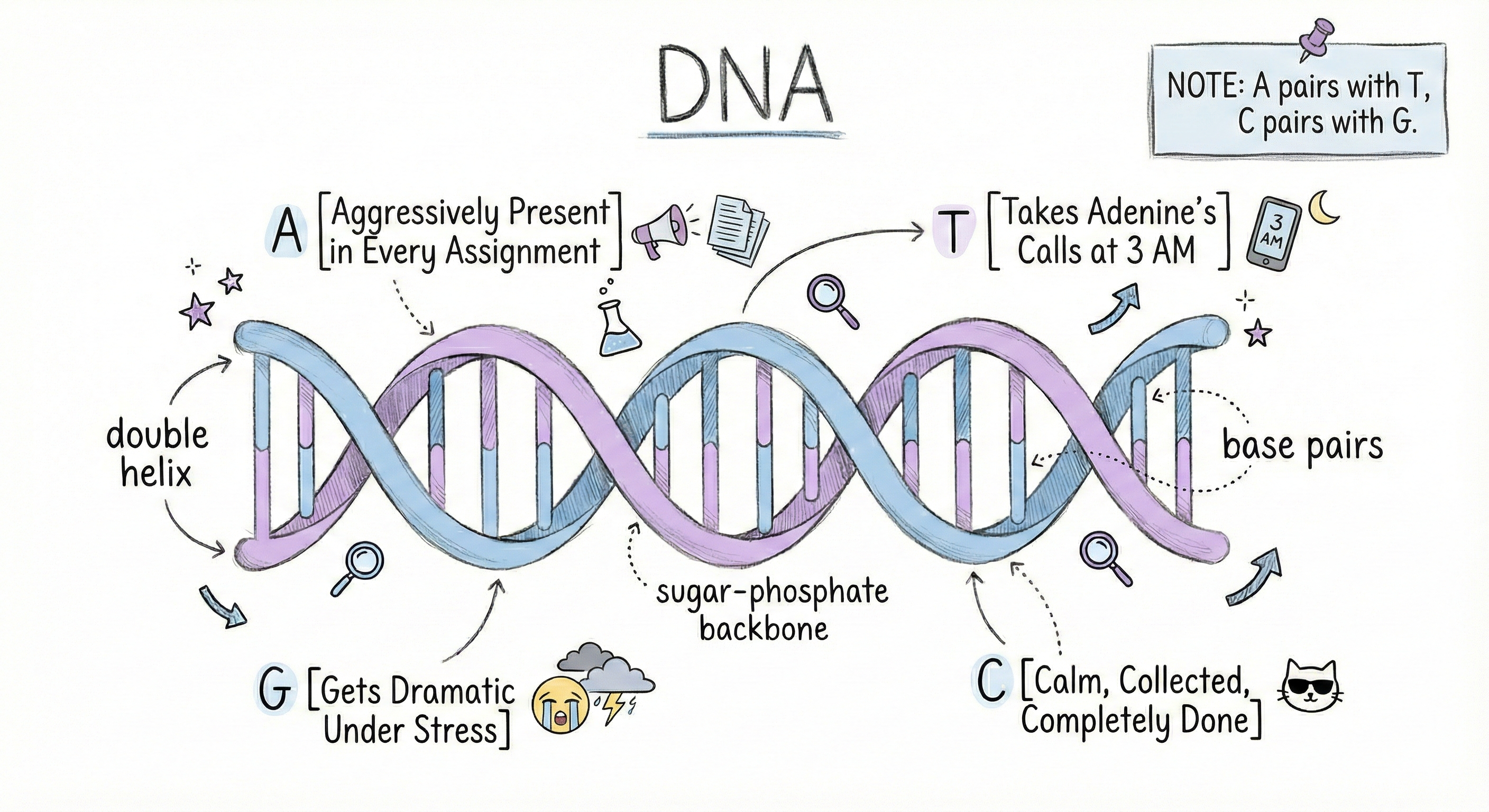
Inside every single one of your cells, and you have about 37 trillion of them, because your body believes in redundancy like a conspiracy theorist believes in backup plans, there's a nucleus. Think of it as a high-security vault. And inside that vault? Your DNA, sitting there like some medieval king who's convinced that leaving the castle is how you get assassinated.
Your DNA contains all the instructions for building proteins, which are the things that actually DO stuff in your body. Proteins are your enzymes, your hormones, your antibodies, your structural support, your everything. If your body were a construction site, proteins would be every single tool, worker, and building material.
But here's the problem that evolution created and then had to solve with the biological equivalent of duct tape:
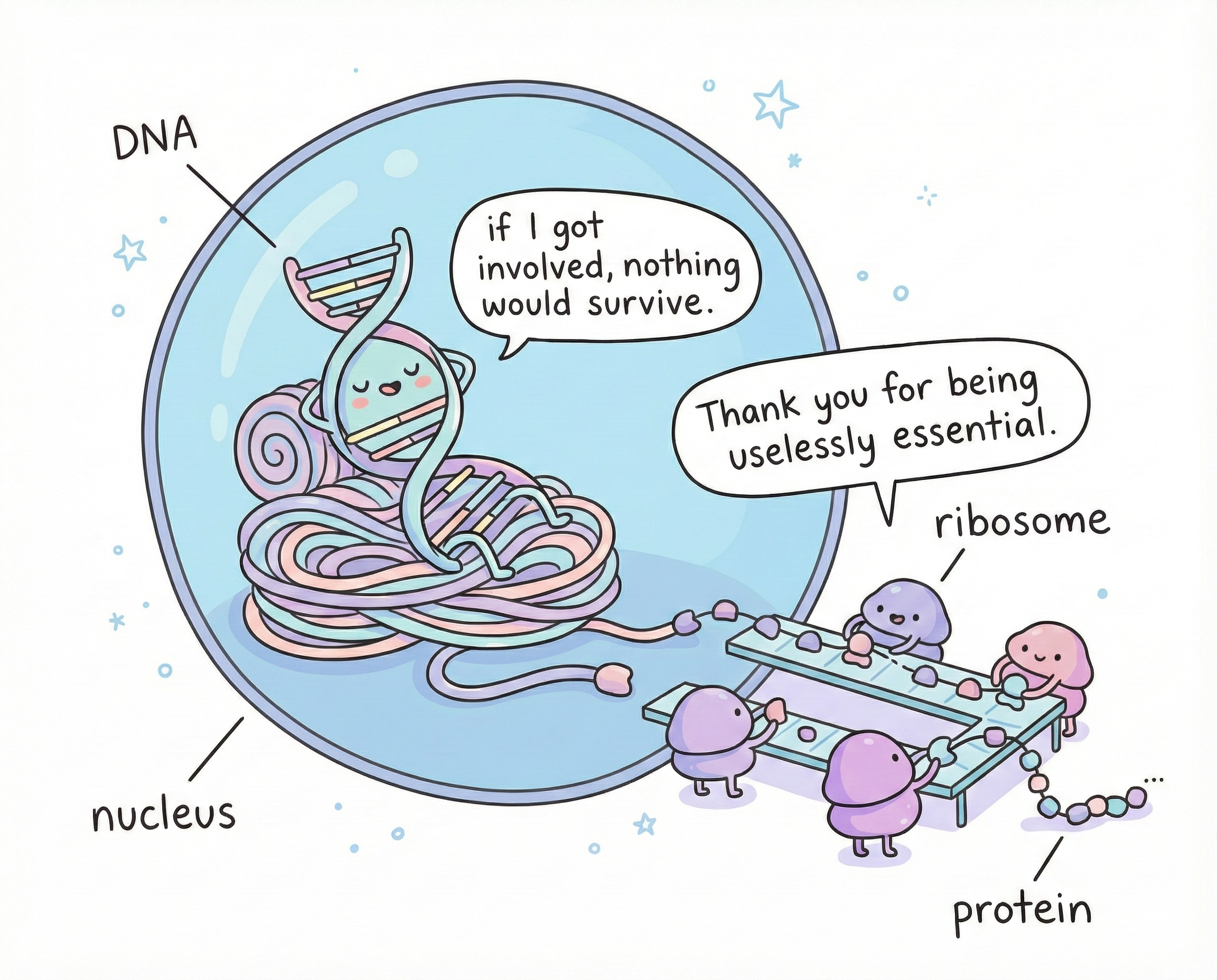
Your DNA is locked in the nucleus. The protein-making factory is OUTSIDE the nucleus.
This is like having the blueprint for IKEA furniture locked in a safe in Sweden while you're in your living room surrounded by unassembled parts, an Allen wrench, and growing existential dread. Your cells looked at this situation and said "Well, I guess we need middle management now."
Enter RNA: The World's Most Overqualified Photocopy
So your cells evolved a solution, and that solution is RNA, Ribonucleic Acid. If DNA is the precious original document that never leaves the vault, RNA is the photocopy that gets sent out into the world to actually get things done.
But let's be clear: RNA is not just "DNA's helper" or whatever your teacher said. RNA is doing the ACTUAL WORK while DNA sits in its climate-controlled office taking credit. DNA is management. RNA is everyone else.
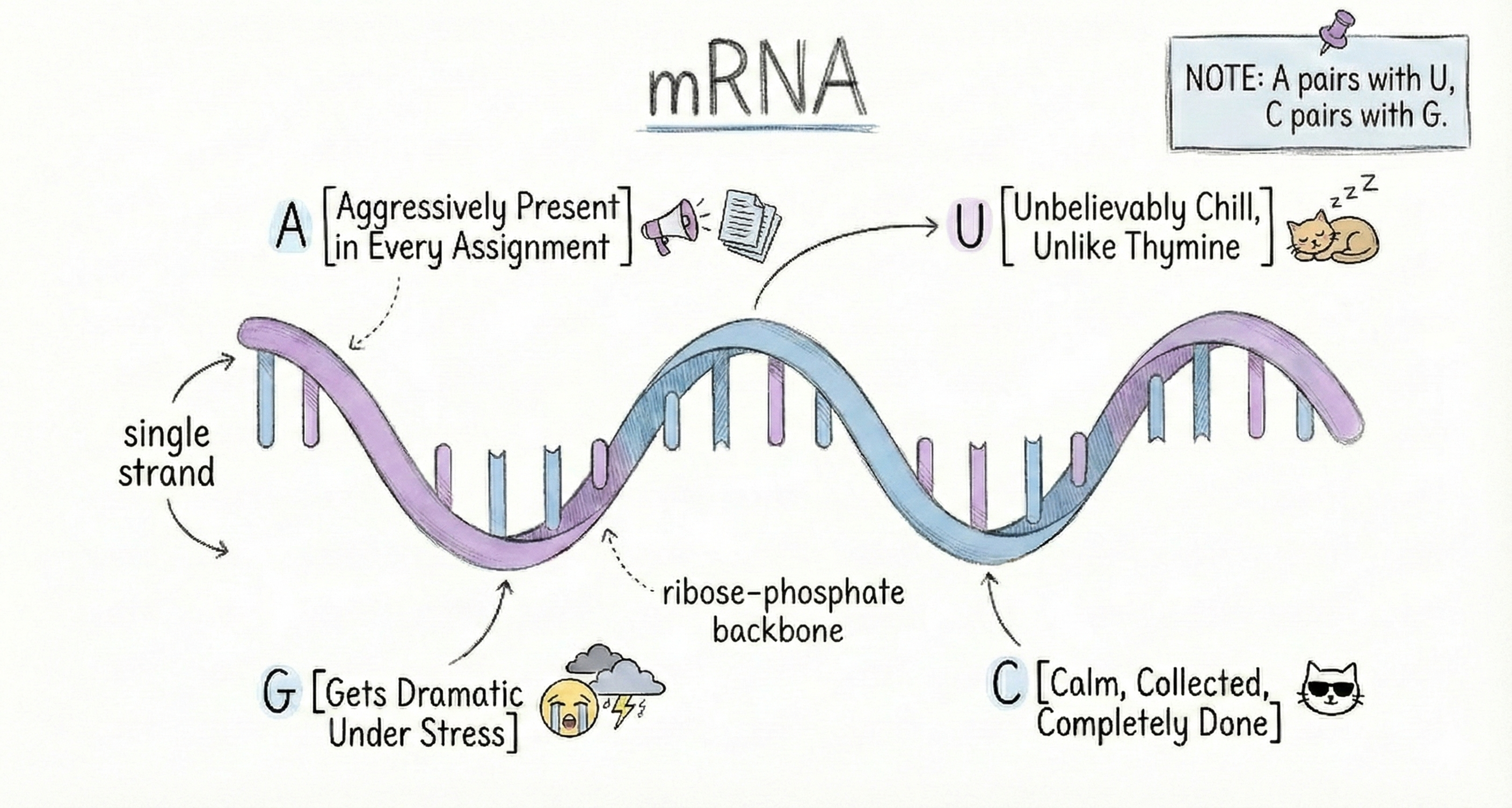
There are different types of RNA (because biology cannot do anything simply), but the star of today's show is messenger RNA, mRNA for short. This is the photocopy courier, the middle manager, the messenger pigeon of your cellular world.
And this is where transcription comes in.
Transcription: Or, "How Your Cells Invented Bureaucracy"
Transcription is the process of making an RNA copy of a DNA sequence. That's it. That's the whole thing. Your cells are literally running a copy machine.
Here's how it works, and I need you to appreciate how unnecessarily complicated this is:
Step 1: The DNA unzips itself
There's an enzyme called RNA polymerase (polymerase means "makes polymers," which is scientist-speak for "builds long chains of stuff"). This enzyme comes along and literally unzips the DNA double helix like it's opening a zipper. The two strands separate, exposing the genetic code hidden inside.
Your DNA just... opens up. In a secure vault. For an enzyme. This is the molecular equivalent of a bank vault that opens when you knock the right way. Security level: questionable.
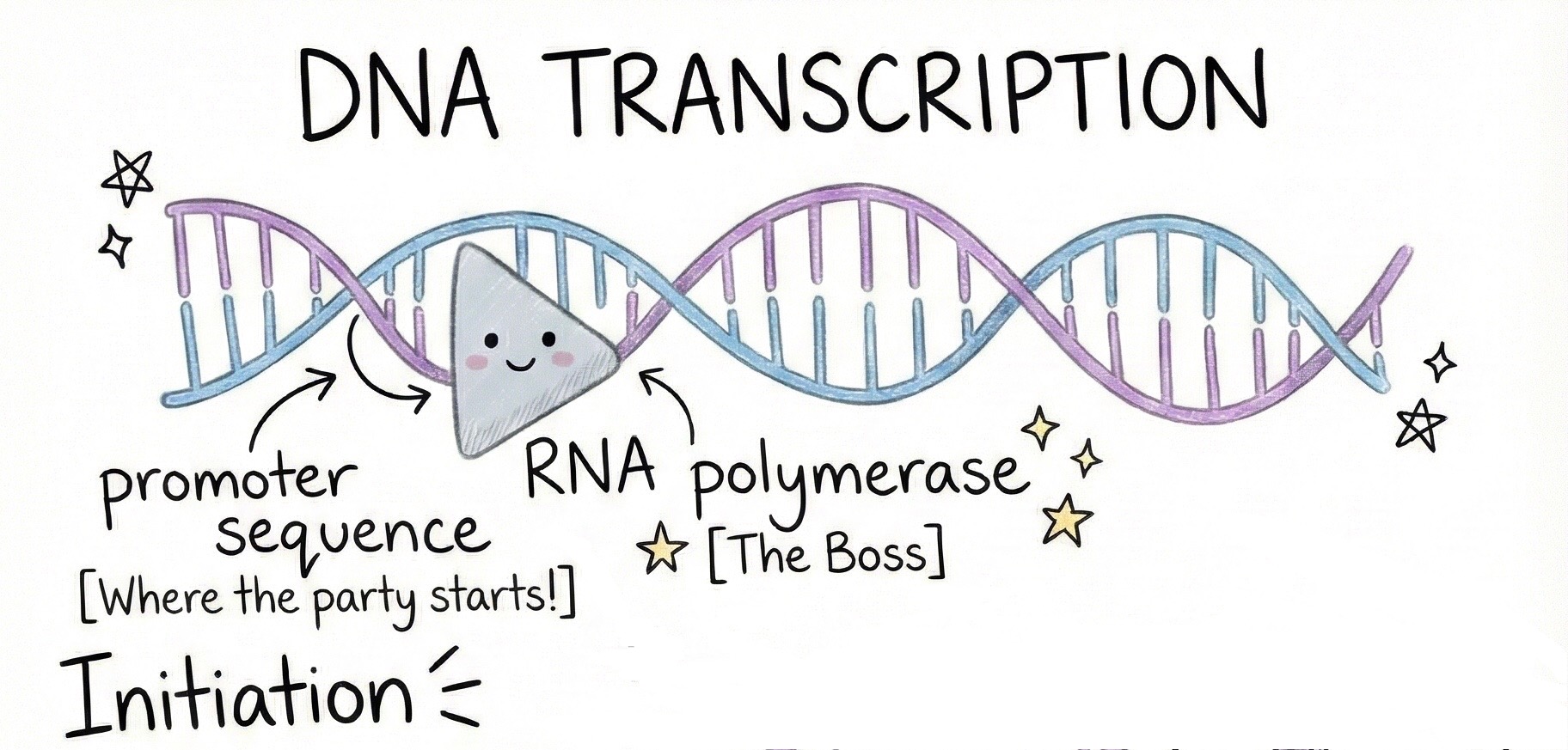
Step 2: RNA polymerase reads the DNA and builds an RNA copy
Now here's where it gets spicy. DNA is made of four chemical letters: A (adenine), T (thymine), G (guanine), and C (cytosine). RNA is ALSO made of four letters, but instead of T, it has U (uracil), because evolution is a jazz musician who likes variations on a theme.
RNA polymerase reads the DNA sequence and builds a matching RNA strand. Where DNA has an A, RNA gets a U. Where DNA has a T, RNA gets an A. G matches with C, C matches with G. It's like a very specific, very nerdy dating app.
The RNA polymerase slides along the DNA, reading the code and building the RNA copy one letter at a time. It's surprisingly fast, about 40 letters per second in humans. Your cells are speed-readers with a 100% accuracy requirement because typos in biology are called "mutations" and they range from "completely fine" to "you now have three eyes."
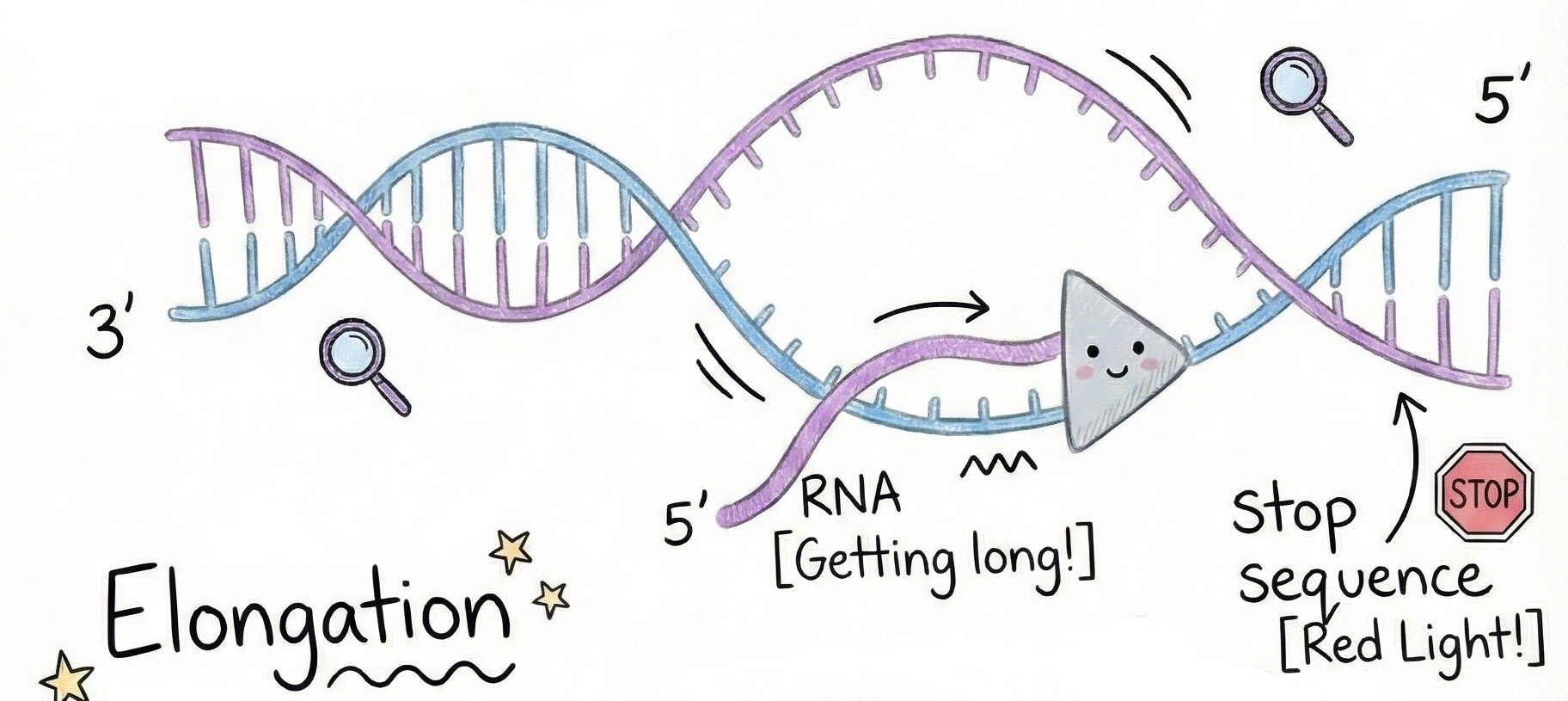
Step 3: The RNA copy detaches and leaves the nucleus
Once the RNA polymerase finishes copying the gene (because yes, it only copies specific PARTS of the DNA, the parts that code for proteins, called genes), the new mRNA strand detaches. The DNA zips back up like nothing happened, ready to be copied again whenever your cells need more of that particular protein.
The mRNA then leaves the nucleus through special pores, which are like the loading docks of the cellular vault, and heads out into the cytoplasm, where the ribosomes are waiting.
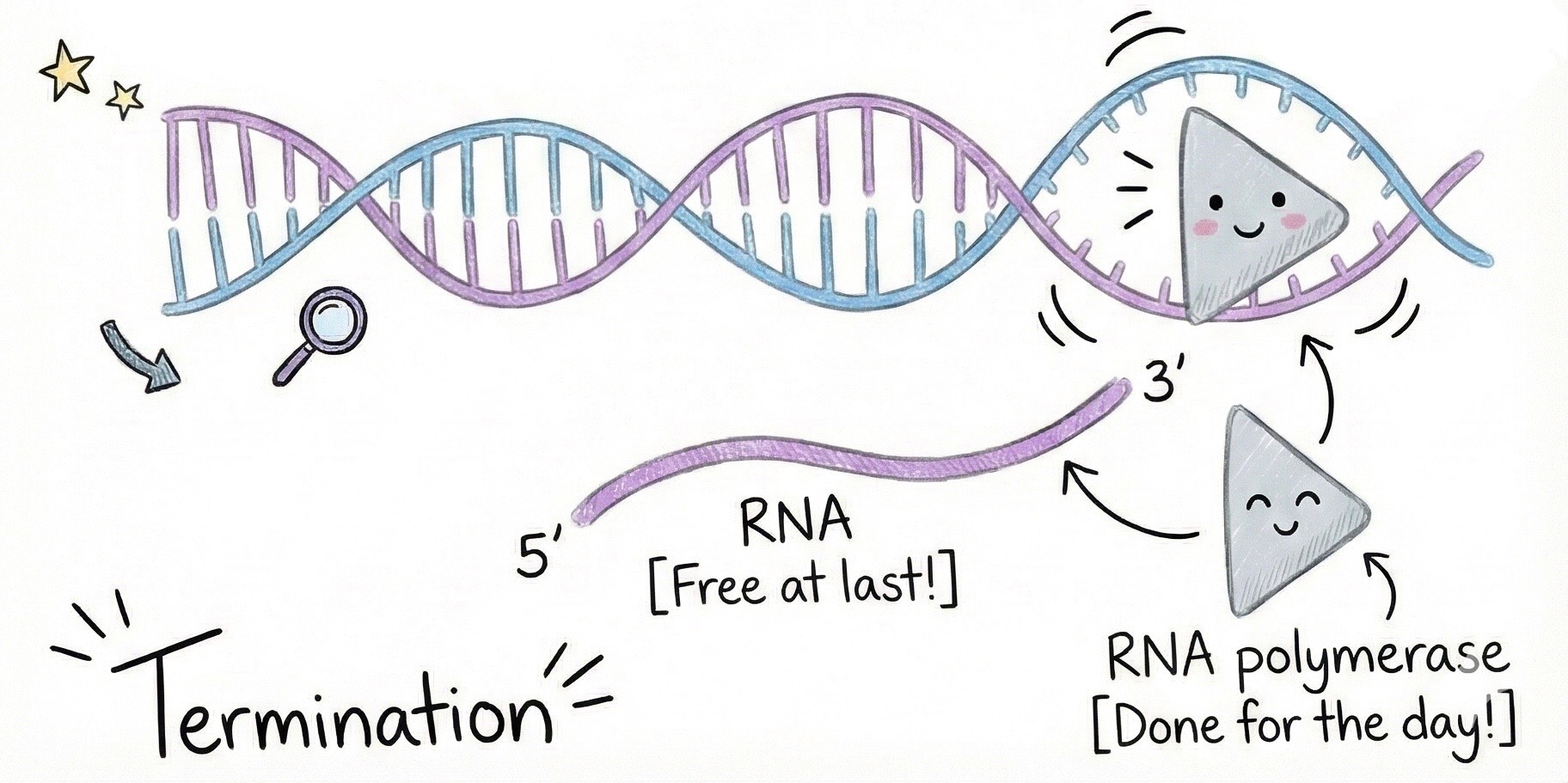
Why Though? Why Is Any Of This Necessary?
Great question. Why doesn't DNA just... make proteins directly? Why the middleman?
Because your DNA is PRECIOUS and FRAGILE and if it left the nucleus every time you needed to make a protein, it would get damaged by all the chemical chaos happening in the rest of the cell. The cytoplasm is a biochemical mosh pit. Your DNA is not moshing.
Also, and this is important, you need to make proteins constantly. Multiple copies. Thousands of them. Your cells need to be able to make lots of insulin, or lots of hemoglobin, or lots of whatever, without copying the entire genome every single time.
So instead, your cells transcribe just the gene they need, make multiple mRNA copies of it, and then each mRNA can be used to make multiple proteins. It's efficient. It's scalable. It's the biological equivalent of "work smarter, not harder."
Your cells figured out distributed manufacturing before humans did, and they did it without a single PowerPoint presentation.
Proteins: The Actual Workers Who Deserve Raises
So what happens to the mRNA after it leaves the nucleus? It gets read by ribosomes, which are the protein-making factories of your cells. Ribosomes read the mRNA code three letters at a time, and each three-letter combo corresponds to a specific amino acid. They string together amino acids in the exact order specified by the mRNA, and boom, you've got a protein.
This process is called translation (because you're translating from nucleic acid language to protein language), and it's a whole other level of molecular insanity that we'll roast in another article.
But here's what you need to know: proteins do literally everything in your body.
- Enzymes (which are proteins) break down your food
- Antibodies (proteins) fight off infections
- Hemoglobin (protein) carries oxygen in your blood
- Collagen (protein) holds your skin together
- Insulin (protein) regulates your blood sugar
- Keratin (protein) is your hair and nails
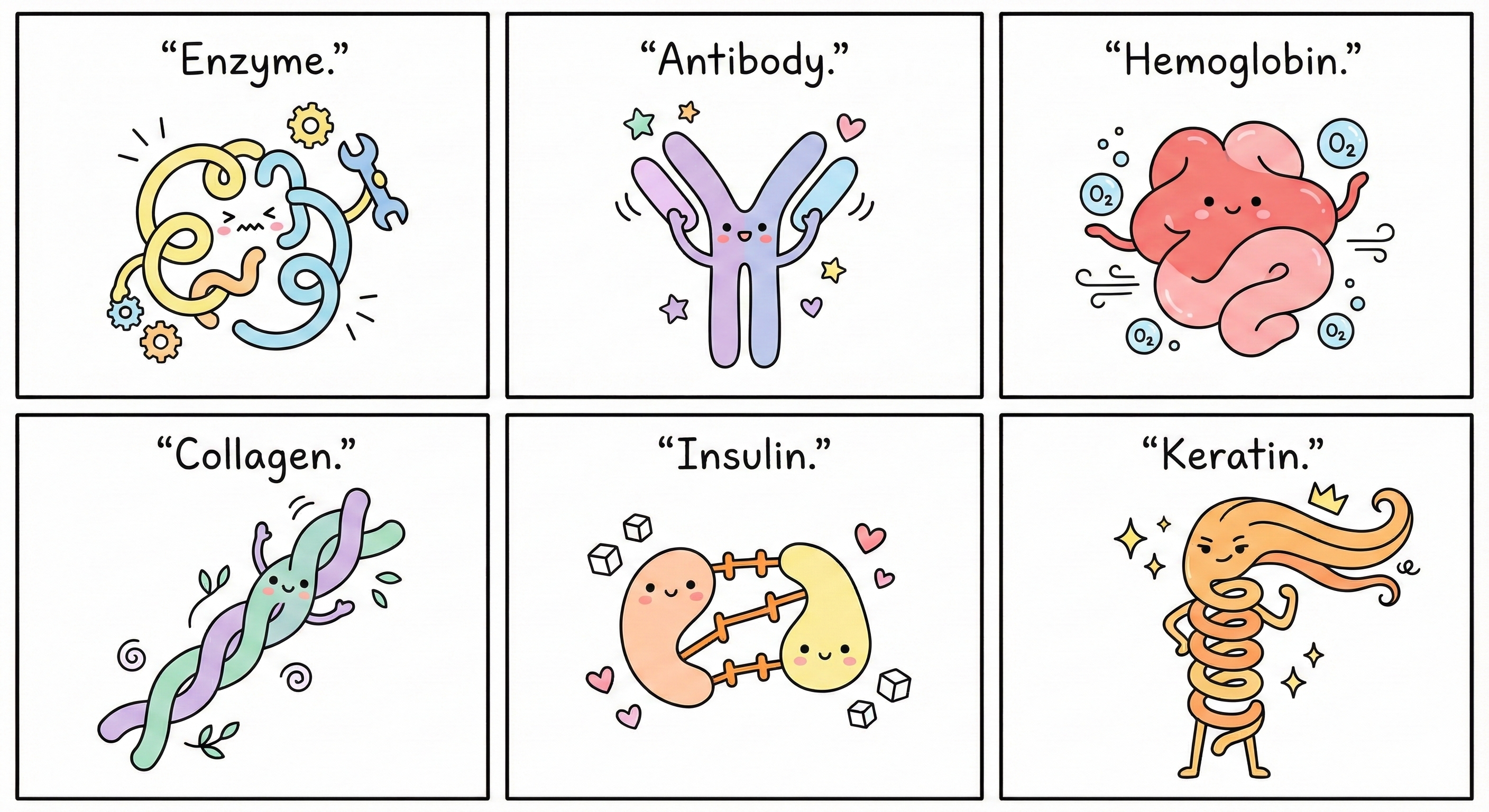
You are basically a meat robot held together by proteins that were built according to instructions photocopied from DNA you've never read and don't understand. And it works. Flawlessly. Billions of times per day.
You're welcome.
Let's Recap Because I Know You Zoned Out
Here's the entire process in a nutshell, for those of you who skipped to the end like this is a recipe blog:
- DNA sits in the nucleus like a paranoid librarian guarding the only copy of an ancient text
- RNA polymerase comes along and makes an mRNA copy of just the gene needed (this is transcription)
- mRNA leaves the nucleus and goes to the ribosomes
- Ribosomes read the mRNA and build proteins (this is translation)
- Proteins go off and do literally everything that keeps you alive
- You continue to have opinions about things while understanding none of this
The Part Where I Get Philosophical
The truly wild thing about transcription is that it's happening RIGHT NOW. In your cells. All of them. Constantly.
While you're reading this, your cells are transcribing genes for digestive enzymes because you ate something. They're transcribing immune genes because you touched a doorknob. They're transcribing repair proteins because you exist in a universe with entropy.
You are a walking, talking molecular photocopy center that learned to be anxious about text messages.
Evolution took billions of years to develop this system, and it works so well that you literally never think about it. You just wake up, exist, complain about being tired, and go to sleep, while your cells are out here running a 24/7 operation that would make Amazon's logistics department weep with envy.
So the next time someone asks you what you've accomplished today, you can confidently tell them: "My cells transcribed approximately 200,000 genes, translated millions of proteins, and kept me alive despite my questionable life choices."
You're welcome for the conversation starter.
Next time on "Trust Me, I'm a Scientist": We'll talk about translation, mutations, and why your DNA is basically playing telephone with your proteins (and why you should be more concerned about that than you are).
Disclaimer: Everything in this article is real. Your cells really are this extra. Biology really is this ridiculous. Welcome to being a eukaryote. There's no exit.