Translation, or How Your Cells Read Assembly Instructions Better Than You Ever Will
Welcome Back to Your Body's Manufacturing Plant
Remember last time when I told you your cells run an elaborate photocopy business? How DNA sits in the nucleus like a paranoid shut-in while RNA does all the actual work? How transcription is basically your cells saying "we need copies of this instruction manual, stat"?
Well, congratulations. You understand 50% of the process. The other 50% is even more ridiculous.
Today we're talking about translation, the part where your cells take those mRNA photocopies and actually BUILD proteins with them. And let me tell you, if transcription was your cells running a copy machine, translation is them running a fully automated assembly line that would make Toyota weep with envy. Except instead of cars, they're building the molecular machines that keep you alive. While you're over here struggling to assemble IKEA furniture with an Allen wrench and a dream.
Quick Recap Because I Know You Forgot
Here's where we left off:
- DNA (the instruction manual) lives in the nucleus
- RNA polymerase makes an mRNA copy of specific genes (transcription)
- mRNA leaves the nucleus and heads into the cytoplasm
- And then... what?
This is where ribosomes enter the chat.
Ribosomes: The Assembly Line Workers Who Never Take Breaks
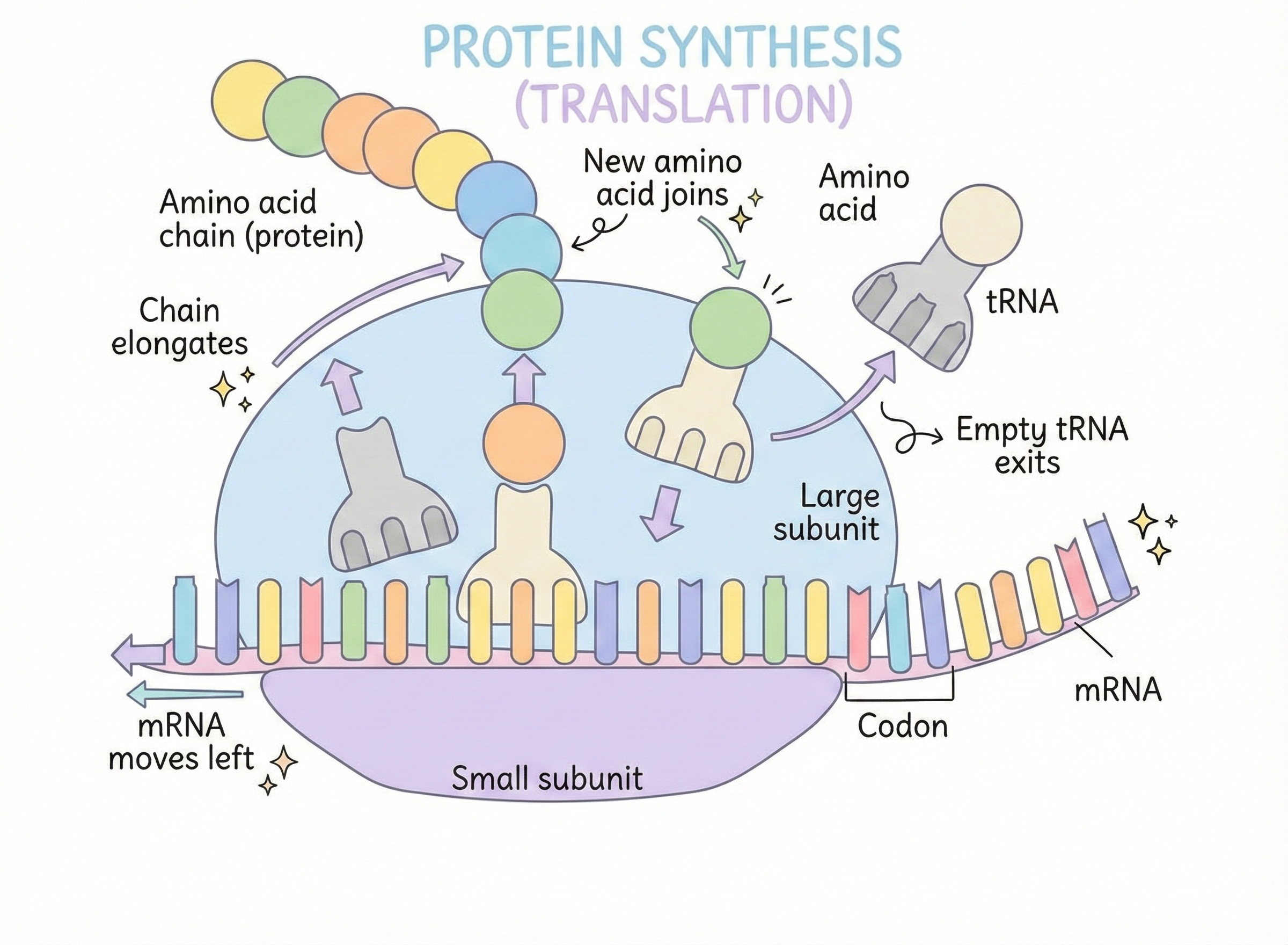
Ribosomes are the protein-making factories in your cells. They're not technically alive (they're just RNA and proteins stuck together), but they're working harder than you've ever worked in your entire life. Every cell has thousands of ribosomes. THOUSANDS. All of them reading mRNA and cranking out proteins 24/7 without complaining, asking for raises, or checking their phones.
A ribosome's entire job is to:
- Grab an mRNA molecule
- Read the genetic code
- Assemble amino acids in the exact right order
- Release a finished protein
- Repeat
That's it. That's the whole job description. And they do it PERFECTLY, billions of times a day, without ever needing a training seminar. Meanwhile, you read the same email three times and still don't understand what your boss wants.
The Genetic Code: A 3-Letter Alphabet That Somehow Works
Here's where it gets wild. The mRNA is basically a long string of letters, A, U, G, and C (remember, RNA uses U instead of T because evolution is quirky like that).
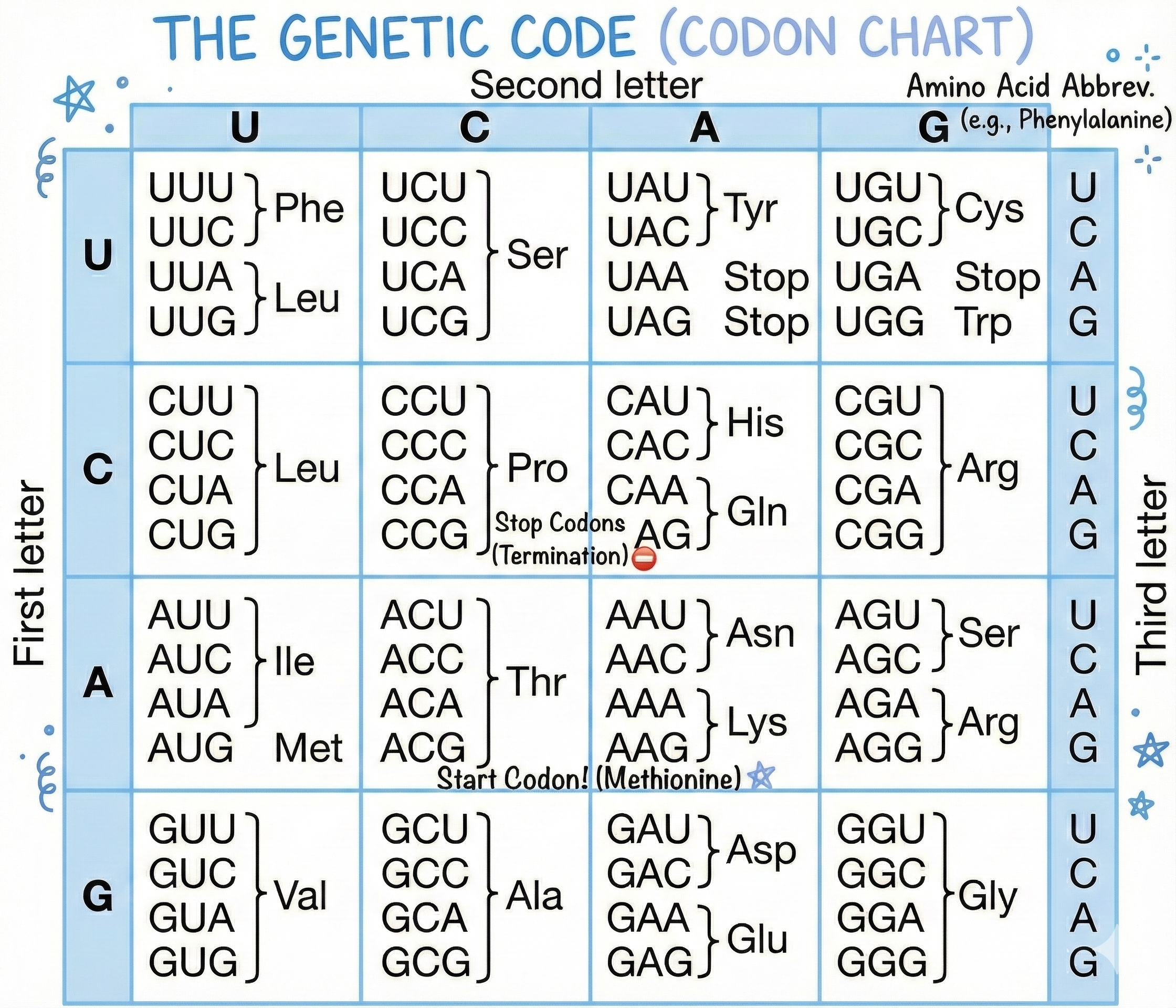
Your ribosomes read this string three letters at a time. Each three-letter combo is called a codon, and each codon corresponds to a specific amino acid.
For example:
- AUG = methionine (also the "start" signal)
- UUU = phenylalanine
- GGG = glycine
- UAA = STOP (end of protein)
There are 64 possible three-letter combinations and only 20 standard amino acids, which means the code has built-in redundancy. Multiple codons can code for the same amino acid. It's like having backup plans for your backup plans, which honestly makes sense when the alternative is "your proteins don't work and you die."
This is called the genetic code, and it's basically universal across all life on Earth. Bacteria use it. Plants use it. You use it. Your dog uses it. We're all running the same software, which is either beautiful or terrifying depending on how you feel about sharing 60% of your DNA with bananas.
Enter tRNA: The Delivery Trucks of Your Cellular World
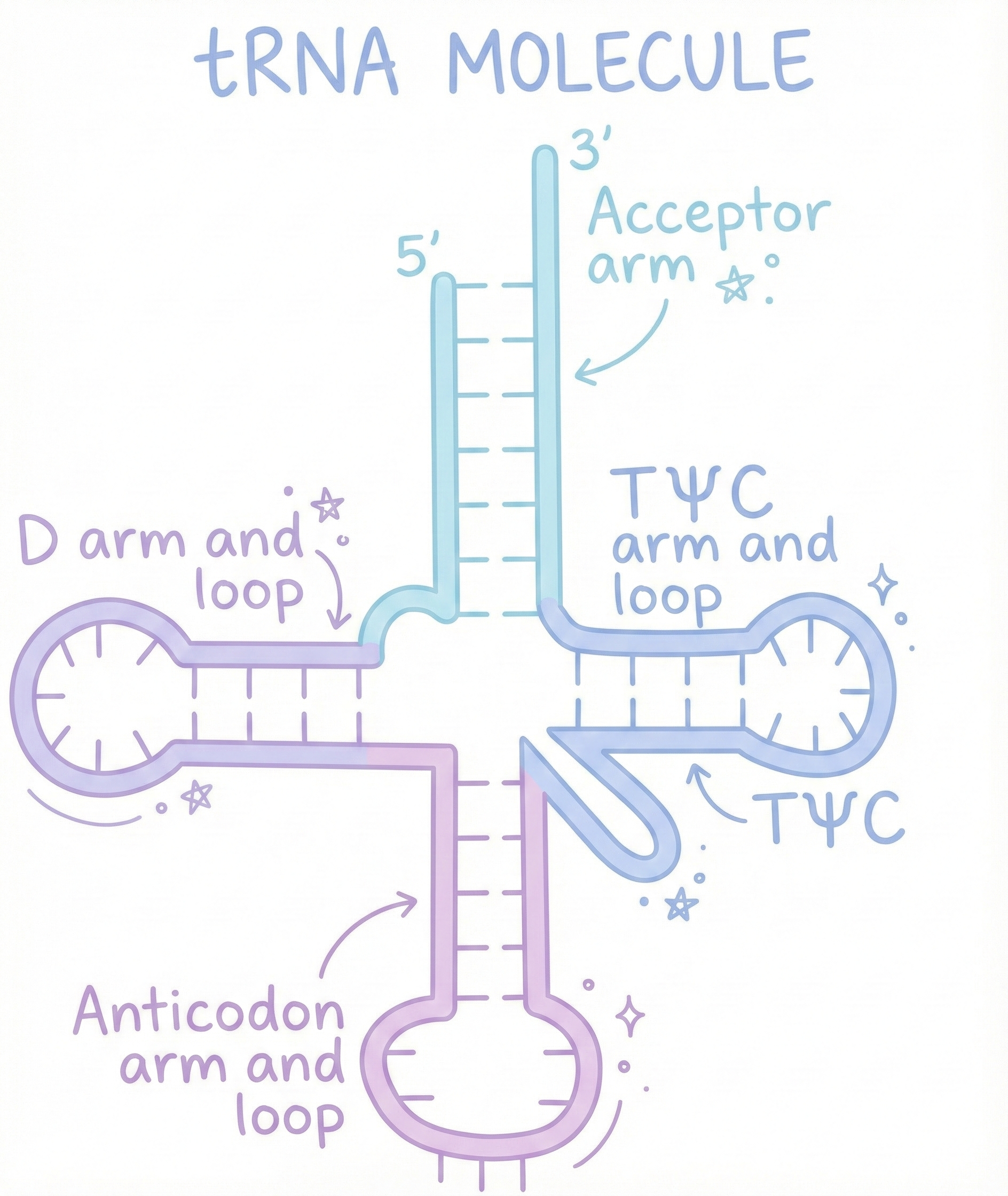
Now here's the problem: ribosomes can read codons, but they can't go fetch amino acids themselves. They're stuck on the assembly line. So your cells invented tRNA, transfer RNA. tRNA molecules are the delivery trucks of the cellular world. Each tRNA:
- Has an anticodon (three letters that match a specific codon)
- Carries the corresponding amino acid attached to its back
- Drives around the cytoplasm looking for ribosomes that need its specific amino acid
It's like a molecular UPS system, except the drivers never get lost, never deliver to the wrong address, and never leave your package on the porch in the rain.
There are different tRNA molecules for different amino acids. Each one knows exactly which amino acid it's supposed to carry and which codon it matches. No confusion. No mix-ups. Your tRNA molecules are more organized than you've ever been.
Translation: The Actual Process (And Why It's Absurdly Elegant)
Okay, let's walk through how a protein actually gets made. Buckle up, because this is where molecular biology shows off. Think of it like building a LEGO set from instructions:
- The mRNA is your instruction manual
- The ribosome is you (the builder) reading the instructions
- tRNA molecules are your friends handing you the exact LEGO pieces you need
- Amino acids are the LEGO bricks
- The finished protein is your completed LEGO Death Star (except it actually works)
Step 1: Initiation (Getting Started)
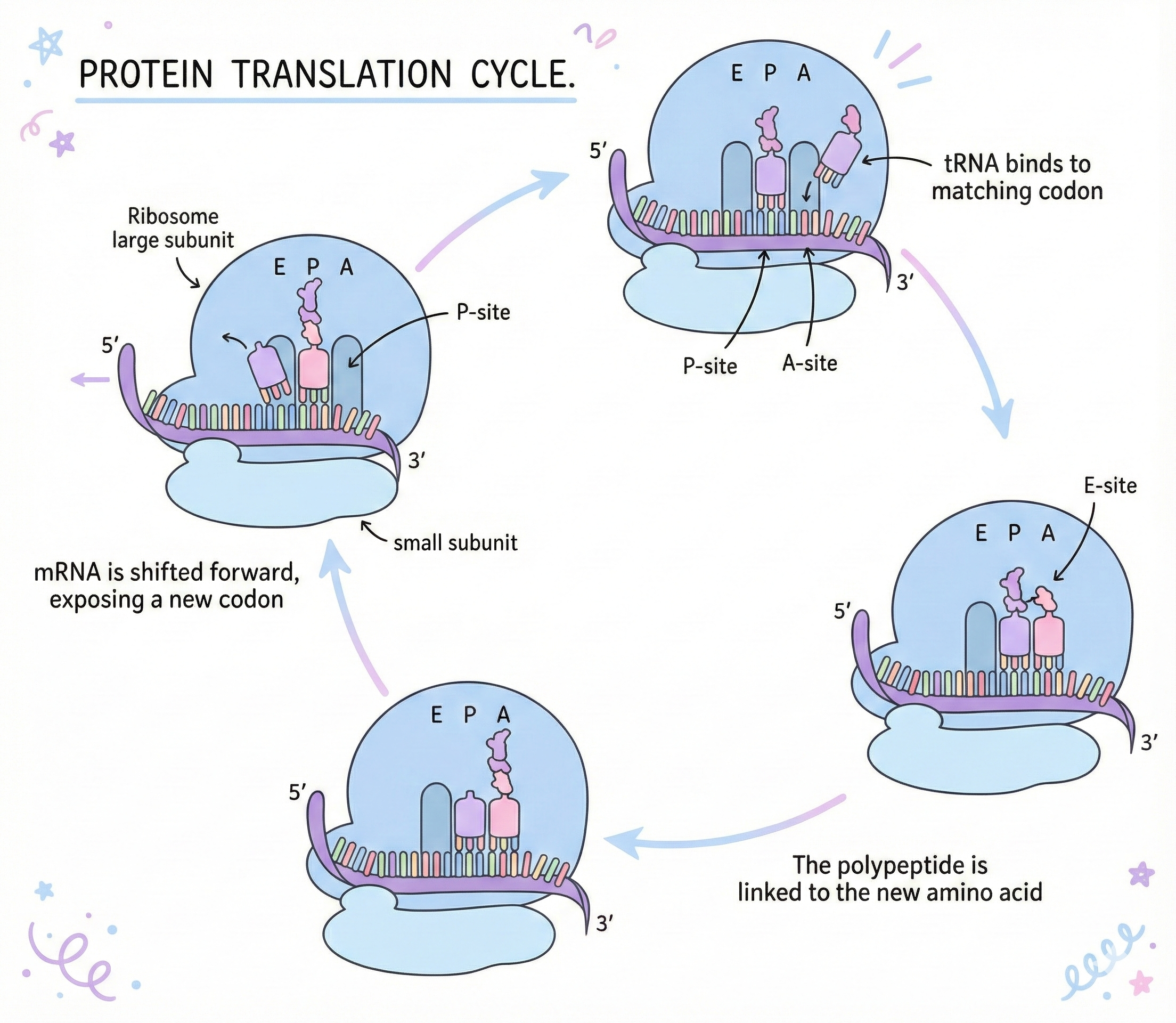
The ribosome grabs an mRNA and finds the start codon, AUG. This is always where translation begins, like the "START HERE" sticker on assembly instructions, except your cells actually read it. A tRNA carrying methionine (the amino acid coded by AUG) comes over, matches its anticodon to the start codon, and boom, you've got your first amino acid in position.
The ribosome has two slots: the P site (where the growing protein chain is) and the A site (where the next amino acid arrives). Right now, methionine is chilling in the P site.
Think of it as you're opening your LEGO instructions to page 1. It says "Start with piece #4712" (that's your start codon). Your friend hands you that exact piece. You snap it onto the base plate. You're ready to build.
Step 2: Elongation (The Assembly Line Kicks Into Gear)
Now the ribosome reads the next codon. Let's say it's UUU. A tRNA with the anticodon AAA (which matches UUU) shows up carrying phenylalanine. It slides into the A site.
The ribosome does some molecular magic and forms a peptide bond between methionine and phenylalanine. Now you have a chain of two amino acids. The ribosome moves one codon down the mRNA (this is called translocation). The first tRNA leaves. The second tRNA shifts from the A site to the P site. The A site is now empty and ready for the next amino acid.
This repeats. Over and over. Codon after codon. The ribosome slides down the mRNA like a train on a track, and tRNA molecules keep showing up with amino acids in the exact right order. The growing chain of amino acids is called a polypeptide. It's dangling off the ribosome like a protein noodle, getting longer with each new amino acid added.
So, you read step 2: "Attach red 2x4 brick." Your friend hands you the red 2x4. You snap it onto the previous piece. Step 3: "Attach blue curved piece." Your friend hands you that exact piece. You attach it. You keep going, step by step, and your LEGO creation gets bigger. Except your friends never hand you the wrong piece, never lose pieces under the couch, and never take bathroom breaks. Your ribosomes are more reliable than your actual friends.
Step 3: Termination (Knowing When to Stop)
Eventually, the ribosome hits a stop codon, UAA, UAG, or UGA. There's no tRNA for stop codons. Instead, a release factor protein shows up and tells the ribosome "you're done here." The ribosome releases the finished polypeptide chain. The mRNA is released. The ribosome disassembles and goes looking for another mRNA to translate.
The polypeptide chain folds up into its final 3D shape and becomes a functional protein. And that protein goes off to do, whatever proteins do. Digest food. Fight infections. Build structures. Regulate hormones. Keep you alive. You're welcome.
So now you've reach the last page of the instructions. It says "FINISHED!" You set down the completed LEGO Death Star. It's done. You can start a new set now. Except in your cells, the "LEGO set" immediately comes to life and starts doing actual work, like if your LEGO Death Star could actually shoot lasers and defend your body from invaders. Your proteins are way cooler than LEGOs.
Let's Talk About Speed (Because It's Insane)
Ribosomes can add about 20 amino acids per second in prokaryotes (bacteria), and about 5-10 per second in eukaryotes (that's you). A typical protein is around 300-400 amino acids long. Your ribosomes can crank out a complete protein in 30-60 seconds.
And remember: you have THOUSANDS of ribosomes per cell. And about 37 TRILLION cells. They're all making proteins simultaneously, right now, while you're reading this and procrastinating on whatever you're supposed to be doing.
Your body is running the most efficient manufacturing operation in the known universe, and you don't even have to think about it. In fact, thinking about it won't help. Your conscious brain is not invited to this process.
Proteins: What Happens Next?
Once the protein is made, it might:
- Fold into a specific 3D shape (this is critical, wrong shape = broken protein)
- Get modified with chemical tags (phosphorylation, methylation, all kinds of -ations)
- Get transported to wherever it's needed (membrane, nucleus, mitochondria, etc.)
- Start doing its job immediately
Proteins are the workers, the tools, and the building materials of your cells. Everything your body does, EVERYTHING, involves proteins:
- Enzymes speed up chemical reactions (like digesting food)
- Structural proteins hold you together (collagen, keratin)
- Transport proteins move stuff around (hemoglobin carries oxygen)
- Antibodies fight infections
- Hormones send signals (insulin, growth hormone)
- Motor proteins make muscles contract
You are held together, powered by, and regulated by proteins that were assembled according to mRNA instructions that were copied from DNA you've never seen. It's molecular manufacturing on a scale that makes human factories look like a kindergarten craft project.
The Part Where This Gets Philosophical (Again)
Here's what gets me about translation: The ribosome doesn't "know" what protein it's making. It's just reading letters and connecting amino acids. It has no idea if it's building insulin or hemoglobin or collagen. It doesn't need to know. It just follows the instructions.
The tRNA molecules don't "know" they're building something important. They're just delivery trucks matching anticodons to codons and dropping off cargo.
The mRNA doesn't "know" what it codes for. It's just a photocopy of DNA that's being read. And yet, somehow, from this mindless mechanical process of "read codon, add amino acid, repeat," you get functional proteins that can:
- Catalyze reactions
- Fight diseases
- Repair damage
- Send signals
- Build structures
- Keep you alive
You are the emergent property of trillions of molecular machines that don't understand what they're doing but do it perfectly anyway. That's either the most beautiful thing you've ever heard or the most existentially horrifying. Maybe both.
Let's Recap Because Your Eyes Glazed Over
Translation in a nutshell:
- Ribosome grabs mRNA and finds the start codon (AUG)
- tRNA molecules bring amino acids that match each codon
- Ribosome connects amino acids together one by one (peptide bonds)
- This continues until a stop codon is reached
- The finished protein is released and goes off to do its job
- You continue existing without understanding any of this
The whole process: DNA (transcription) → mRNA (translation) → Protein
This is called the Central Dogma of Molecular Biology, and it's the most important thing happening in your body right now.
Why You Should Care (Even Though You Don't Have To)
Translation is happening in your cells constantly. When you eat, your cells make digestive enzymes. When you get cut, they make clotting factors. When you're sick, they make antibodies. When you work out, they make muscle proteins.
Every single protein in your body was made this way. Every enzyme. Every hormone. Every structural protein holding your skin together. Your cells are running a just-in-time manufacturing system that responds to your needs in real time, and you have absolutely zero conscious control over it.
You can't tell your ribosomes "hey, make more insulin." They already know. They're reading the signals. They're responding. They're building proteins without asking your opinion. You're not the CEO of your body. You're not even middle management. You're the building the factory is located in, and the factory is running itself.
But here's the question: if we know HOW proteins are made, can we design NEW ones?
Next time on Trust Me, I'm a Scientist: NVIDIA's protein research explained. From gaming GPUs to drug discovery. How AlphaFold got 138x faster. Why you can now design proteins by describing them in plain English. And why understanding the biology matters more than understanding the AI.
Spoiler: Your gaming GPU architecture is being used to cure diseases. It's weird. I'll explain.
Disclaimer: Everything in this article is real. Your ribosomes really are this good at their job. You really are this bad at IKEA. Welcome to being alive.